
As NewSpace programs continue to push for faster deployment schedules, spacecraft developers are increasingly looking for ways to reduce integration time, simplify power system design, and accelerate mission readiness. In our recent webinar, Powering NewSpace Missions Faster: Integration Solutions that Decrease Time to Market, VPT's Director of Engineering discussed how the proven reliability of the VSC Series combines with the flexibility of the FLX Series to help engineers optimize SWaP, streamline integration, and reduce development risk.
As a follow-up, we've compiled and answered the top questions raised during the event.
VSC Reliability & Qualification
1.) What protection circuitry would you recommend in addition to the ones already offered for the VSC100 Series?
The appropriate protection circuitry depends on the specific system design. Common overvoltage protection approaches include:
- SVRPM Overvoltage Protection Module (upcoming accessory): Monitors input voltage and automatically shuts down the converter if the voltage exceeds a predefined threshold.
- Fuses: Many systems incorporate input and output fuses to protect against excessive current draw. If current exceeds the fuse rating, the fuse opens the circuit to prevent damage.
- Inrush current limiter
Because protection requirements vary by application, the best solution depends on the overall power system architecture that needs to be addressed.
2.) Do you provide FMECA, SPF, or WCA documents with the VSC Series?
No, we do not provide FMECA, SPF, or WCA for the VSC Series. If this type of reporting is needed for your space mission or program, we suggest exploring our hermetic hybrid space-grade SV, SVL, SVR, and SGRB Series.
Customers can receive analysis for these higher level, radiation-hardened power solutions.
3.) Do VPT's space DC-DC converters require additional derating, or are they already derated by design? Other DC-DC converter vendors require additional derating.
VPT designs its products for high-reliability applications and performs all necessary thermal and voltage derating internally. The specifications published in the datasheets already reflect these derated operating limits and represent the converter's full electrical performance.
All testing is conducted on the converter alone, without any additional external components, and ratings are based on the maximum allowable baseplate temperature.
As a result, customers do not need to further derate or add additional components, they only need to ensure the converter’s baseplate temperature remains within the specified limits (found on each product’s datasheet).
4.) Can we make a custom VSC unit?
We can sometimes accommodate requests for non-standard output voltages or other minor product modifications, provided there is a valid business case. These changes are typically implemented as "mini-mods," which are small adjustments to an existing product rather than the development of a completely custom design.
VPT generally avoids creating fully custom converters, but the mini-mods that we design are often added as a standard option on an existing datasheet. Customers interested in a modified product should contact the sales team to discuss their specific requirements.
5.) What standard do you use when derating components for the VSC Series?
We follow our own internal electrical derating guidelines as part of the design process for our high-reliability power products. While these derating requirements are incorporated into the product design and specifications, we can also share detailed derating information with customers upon request when additional technical insight or application-specific guidance is needed.
6.) Can we use the VSC Series for critical missions?
The VSC Series was developed as a more affordable, lower risk power solution for low Earth orbit (LEO) applications rather than long-duration or manned missions.
For more demanding, long-term missions, we have a variety of products lines the SV, SVL, SVR, and SGRB Series which are built with the highest-grade components and qualification standards.
7.) Are any of the VSC Series already in orbit?
The VSC Series has been successfully deployed in multiple space missions and has numerous units currently operating in orbit. Although the product line was introduced in 2022 and is relatively new, it was specifically developed for the fast-moving LEO (low Earth orbit) market, where adoption and deployment cycles are much shorter.
As a result, the series has achieved a growing track record of successful missions. While we do not disclose specific customer programs, the number of missions using VSC products continues to grow.
8.) How is the VSC qualification different from the standard automotive grade power supply?
The VSC Series qualification process includes environmental testing similar to automotive-grade products, such as shock, vibration, mechanical stress, spin testing, and temperature cycling. However, a key differentiator for space applications is radiation qualification.
Unlike automotive power modules, VSC Series undergo radiation hardness assurance, with both the overall product and critical components evaluated for radiation performance. VPT continuously qualifies components before they are incorporated into VSC products to ensure suitability for the space environment. The result is a power converter designed to meet the environmental and radiation challenges of NewSpace and LEO missions.
9.) What is the difference between the VSC Series and the SV Series?
The VSC Series and SV family (SV, SVL, SVR) products are designed for different mission requirements, with the primary distinctions being cost, construction approach, radiation performance, and screening level.
SV, SVL, and SVR Series are intended for critical, long-duration, and deep-space missions. They feature:
- Higher radiation tolerance
- Aluminum nitride substrates
- Bare-die construction
- Radiation-hardened components
- Extensive screening, often including Class K requirements
- Hermetically sealed packaging
VSC Series is optimized for the cost-sensitive NewSpace and LEO market.
- Printed circuit board (PCB) construction
- Up-screened plastic components
- Rugged, low-outgassing epoxy encapsulation
- Reduced screening compared to the SV family
- Design features that still withstand harsh launch shock and vibration environments
Additionally, Worst Case Analysis (WCA) is not provided for the VSC Series, reflecting its focus on affordability and streamlined qualification rather than the highest level of mission assurance
10.) Where do you complete your radiation testing and SEE testing?
We leverage the expertise of its sister company, VPT Rad, to support radiation testing and qualification activities for the VSC Series. VPT Rad operates an in-house Cobalt-60 radiation source, enabling both high-dose-rate and low-dose-rate testing, while the team also conducts Single Event Effects (SEE) testing at Texas A&M University.
This close collaboration has been instrumental in developing and validating the radiation performance of the VSC Series, helping ensure the products meet the reliability requirements of NewSpace and LEO applications.
11.) What kind of support can you offer when a customer faces EMC issues?
For customers using the FLX Series, all required testing and qualification activities are completed before delivery, so the units arrive fully qualified and ready for integration. For EMC compliance questions related to other products, our technical support team can provide guidance and application-specific assistance.
A key differentiator for VPT is its hands-on engineering support, helping customers address not only EMC concerns but also broader power system challenges. Customers needing technical assistance can connect directly with a VPT engineer through the Ask an Engineer program on the VPT website.
VSC Technology & Roadmap
12.) Will you make an SMD DC-DC converter with 28 V input?
Yes, we have a variety of hybrid 28 V input DC-DC converters on SMDs. You can find this information on each product’s data sheet.
13.) Are there any plans to make a converter that offers higher efficiency at the lower end of the power output range? The VSC15/30/100 curves seem to nearly overlap.
This is a great suggestion. However, at the moment, we do not have any products on our product roadmap to improve efficiency.
14.) Any plans to go to higher power density modules?
Yes, we are always looking at expanding and developing higher power units.
15.) Are GaN MOSFETs used for the VSC Series?
We currently use silicon MOSFETs in the VSC Series and do not use commercial GaN devices. While we have significant experience with gallium nitride (GaN) technology through its SGRB high-voltage DC-DC converter family, those products utilize radiation-hardened GaN components, which are substantially different from commercial-grade GaN devices. We have evaluated commercial GaN technologies but have not identified any that meet its reliability and performance requirements for space applications. Because the commercial GaN market continues to evolve rapidly, VPT believes the technology needs to mature and stabilize further before it would be considered for use in the VSC Series.
16.) Do you offer higher input voltage parts?
For space applications, we offer 50 V input hybrids as well as 100V and 120V SGRB Series. For non-space applications, we have a 270V input VXR line.
17.) Do these converters have dual sided heat sinking?
The VSC Series converters are fully encapsulated in a thermally conductive material and operate from -55°C to +105°C. The +105°C rating is measured at the thermal interface (baseplate), not the ambient temperature. Because the baseplate can be mounted either on the top or bottom, the converters offer greater installation flexibility while still meeting thermal requirements, making system integration easier.
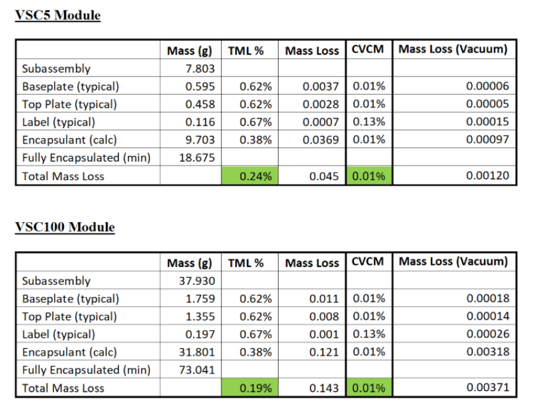
18.) Can you share more about low outgassing?
The epoxy used in VSC Series converters and EMI filters is specifically tested for low outgassing.
19.) Can you combine the converters to get more power?
Lower-power VSC converters cannot be paralleled because they do not include a current-sharing function. However, you can stack the outputs to increase the output voltage while maintaining the same current.
For example, two VSC5-2805S converters can be stacked to create a 10V output at 10W, with each converter providing 5W. In most cases, using a single higher-power converter is preferred because it is typically smaller and more cost-effective than combining multiple lower-power units.
FLX Integration & Connectors
20.) What kind of input/output connectors are used on FLX solutions? A D-Sub or any other rugged connector?
The FLX Series uses D-Sub style connectors as its standard interface. While this is the default connector option, VPT offers flexibility for customers with large production volume or specific application needs. Alternative connector configurations can be evaluated and accommodated as part of a customization effort.
21.) Can you do custom connectors on the FLX box?
Yes.
22.) Does the FLX Series have flight heritage?
The FLX Series architecture is based on technologies that already have demonstrated flight heritage. Our SGRBX box-level power module has flown successfully, and the individual converter modules that can be integrated within an FLX solution also have flight heritage.
As a result, although a specific FLX configuration may be customized for a customer's application, the underlying building blocks are derived from proven, flight-tested designs.
23.) Is this a custom design? How many features can we add?
We offer multiple box-level power module designs, providing customers with a range of options depending on their application requirements. For details on available configurations, features, and customization options, customers should contact their authorized distributor or VPT representative. Additional technical information and product specifications can also be found in the relevant product datasheets.
24.) How much power can the FLX provide?
The maximum output power of these box-level solutions depends on the customer's application requirements. Because the products can be paralleled, there is no fixed upper power limit imposed by a single unit. We have evaluated systems reaching up to approximately 5 kW, and higher-power configurations can be achieved by combining multiple boxes. The modular architecture allows customers to stack or parallel multiple units to meet specific power demands.
25.) Can a FLX box provide an output voltage different than the typical values on the datasheets.
There are several ways to achieve a different output voltage, depending on the required voltage and power level. In some cases, we can modify the converter design to provide a specific output voltage. However, the simplest and fastest approach is often to use existing product features such as trimming the output or stacking.
Thermal Design & Spacecraft Integration
26.) For our NewSpace LEO application, our baseline concept is to use the SVLFL2812S/H+ as a conduction-cooled converter. The preferred approach is to mount the converter directly onto the platform cold plate through the recommended TP-001 thermal pad, making the cold plate the primary heat rejection path rather than the PCB. Would VPT consider this the optimal thermal architecture for maximizing performance and thermal margin in orbit?
Yes this is good approach. The main consideration is to keep the baseplate below the 125°C rating.
27.) What is the preferred mechanical orientation of the SVLFL2812S/H+ to maximize conduction cooling? Should the converter baseplate be considered the primary thermal interface, or do you recommend extracting heat from multiple package surfaces?
The main thermal path is through the baseplate. The other surfaces provide very little conduction cooling because of the contact area with the heat dissipating components.
28.) What thermal resistance (junction-to-baseplate and baseplate-to-cold-plate) should be assumed for worst-case thermal analysis of the SVLFL2812S/H+ at full load in vacuum?
Each part is made of many different components each with a different thermal resistance to the baseplate. Our thermal analysis analyzes each one for margin.
Pricing & Lead Times
29.) Can you comment on the unit price delta between a hybrid and a VSC? I have heard a VSC is on the order of 1/10th the price of a hybrid.
Cost differences between our product families can vary significantly depending on the required qualification level, screening, and mission assurance requirements. As a general rule of thumb, a comparable VSC Series converter may cost roughly 1/10th of the price of an SV Series equivalent. However, this should be considered only a broad estimate, as the actual cost ratio depends on factors such as testing, radiation requirements, screening levels, and specific program needs.
30.) What's a typical lead time, if there is such a thing as typical, for a FLX order?
Lead times for our products and custom solutions vary based on several factors, including the amount of engineering effort, product modifications, qualification requirements, screening levels, and any analysis or documentation needed to support the application.
Some products are available with shorter lead times than others, while customized solutions may require additional development and review. Because lead time is highly dependent on the specific technical and program requirements, we recommend discussing the details of the project with our sales team to receive a more accurate estimate.


